A first worldwide crowdsourced project on famous and mysterious Voynich manuscript .
This project is about new kind of research on so called Voynich manuscript. Within our crowdsourced project, accesible here, can anyone help with identification of any object in manuscript as well as with manuscript letters or part of the text.
Anyone can join the project, experts, scientists, workers, travellers, simply anyone who seriously want to contribute.
The project is located at the Zooniverse server that support crowdsoucing in general. The project handling is very simple, intuitive and anyone can handle it.
Our team consist of researchers with various fields of expertise. Mostly linguistic, Mathematics, AI and old culture and tribes specialists.
Are you willing to contribute? Just see our guide, register at the Zooniverse server and you can start.
The Voynich manuscript is an illustrated codex hand-written in an unknown, possibly meaningless writing system. The manuscript is named after Wilfrid Voynich, a Polish book dealer who purchased it in 1912. The vellum on which it is written has been carbon-dated to the early 15th century (1404–1438), and the text may have been composed in Italy during the Italian Renaissance. However, its origins and authorship are not unambiguously known, and remain the subject of study and speculation. Some of the pages are missing, with around 240 remaining. The text is written from left to right, and most of the pages have illustrations or diagrams. Some pages are foldable sheets of varying sizes.
The Voynich manuscript has been studied by many professional and amateur cryptographers, including American and British codebreakers from both World War I and World War II. The manuscript has never been demonstrably deciphered, and the mystery of its meaning and origin has excited the popular imagination, making it the subject of novels and speculation. None of the many hypotheses proposed over the last hundred years have been independently verified. In 1969, the Voynich manuscript was donated by Hans P. Kraus to Yale University's Beinecke Rare Book and Manuscript Library, where it remains.
More at Wikipedia.
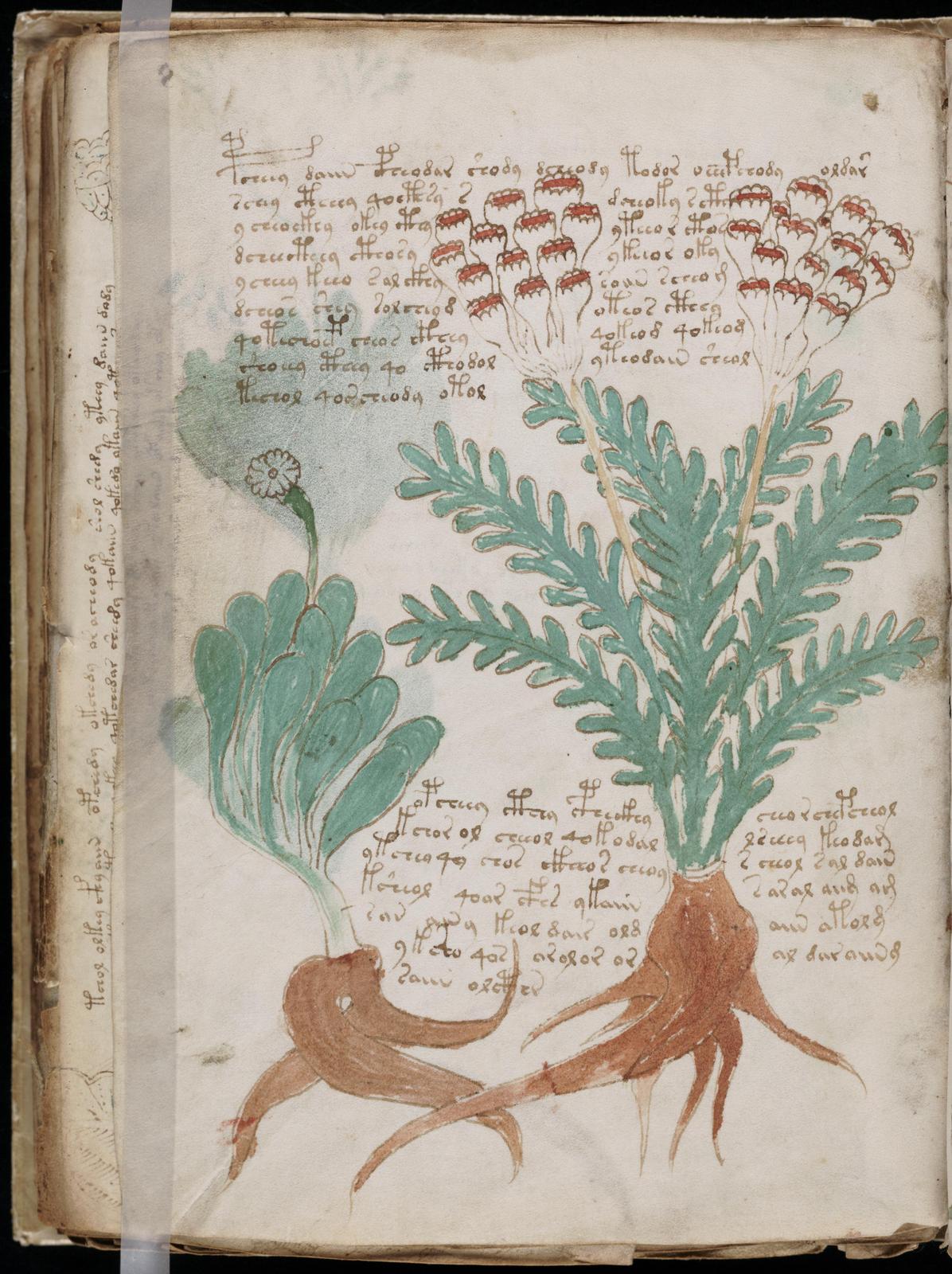
Just a fraction taste of our research...
We have analyzed the texts and based on the structure of the language, we think that it's not fake, but an actual language or dialect. We took the Bible book in English and computer translation of the Voynich manuscript and ran some experiments on these two books to compare the languages...
Another experiment is based on a complex network and its representation. Again we took the mysterious text and compared its visualised network with randomly generated text. The conversion of the text is done in a simple manner - the words in the text are taken as the graph nodes and its ordering as the edges of the graph. Any logical text also follows certain grammatical rules and some repeated patterns must be observable - all of this information can be found in the complex network of the analyzed text. Based on our experiments we believe that the manuscript fulfils all of the above and is written in a real, maybe encrypted, language.
If you are interested in more, contact us
TBA
Share and join us at Zooniverse: